TheHelpful.com Hub
🛠️
T-Pop
The Algorithmic Music Toy
We interact with text constantly, but we experience it visually: we read words, sentences, and code. However, at its core, text is just data: a sequence of discrete characters. I'm interested in new ways to visualize (or in this case, audiolize) data. I asked a simple question: What if you could hear what you were typing?
T-Pop is an experimental browser-based synthesizer that performs a process called "sonification." It takes input data – in this case, the letters and symbols you type – and maps them onto a musical scale.
Every character on your keyboard has a unique digital code behind it. T-Pop takes those codes and translates them into specific audio frequencies. When you type a sequence of letters, you are essentially inputting a musical score that the engine then plays back to you. As a special extra treat, each character creates a different pulse of color from around the color wheel
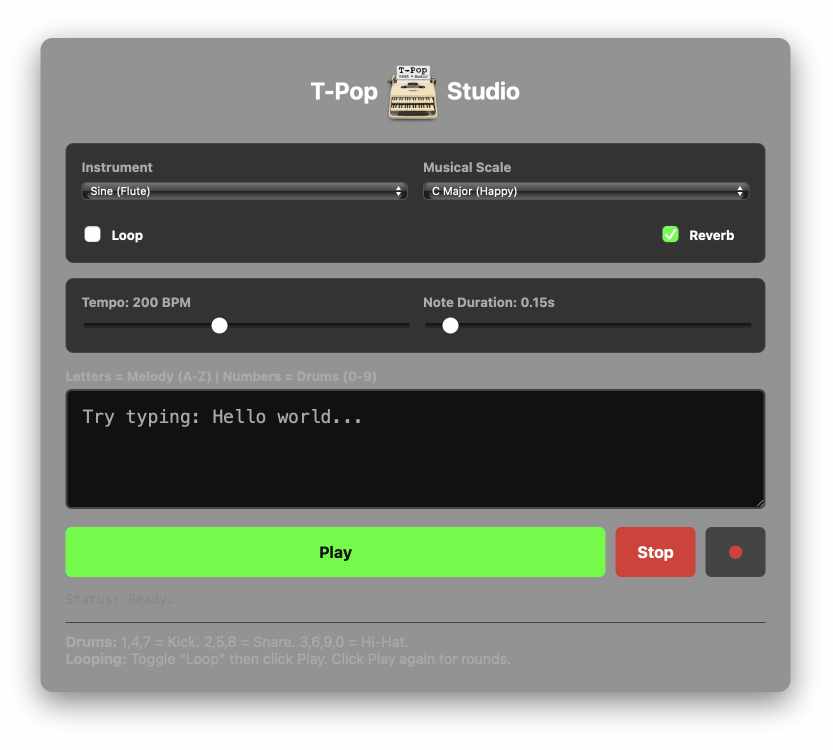
Fine-tuning
Pick from four different instruments (okay, waveform types), and try the four different musical scales to change the underlying music structure. If you'd like a 'no bum notes' experience try the wind chime-like Pentatonic scale.
- C Major (Happy) (The Default): sounds like a standard song or nursery rhyme
- C Pentatonic (Dreamy): this removes 'dissonant' notes (like F and B in the key of C). This is the safest scale; mash the keyboard randomly and it will almost always sound pleasant and Zen-like
- C Minor (Sad): this lowers the 3rd, 6th, and 7th notes. It instantly makes text sound serious, sad, or dramatic
- C Blues (Jazzy): a 'Hexatonic' scale that adds a blue note (sharp 4th). It gives the text a jazzy, improvisation feel
Tweak the tempo to play faster or slower, adjust the note decay time with the Duration slider, and add Reverb for a richer, more spacious sound.
Percussion and pauses
While letters produce notes, numbers create persussion sounds. There are three types you can play with; kick drums, snare and high hats. For better timing control, even syncopation if you're creative with your sentences, use spaces and punctuation:
- 1, 4 and 7 are kick drums
- 2, 5 and 8 are snare drums
- 3, 6, 9 and 0 are high hats
- Notes advance time by one beat
- A space advances time by half a beat (a short breath)
- Commas advance time by one beat (a standard 'speaking' pause)
- Period/full stop and other sentence terminators (. , ! ? ; :) advance time by two beats (a sentence-delineating pause)
Polyphonic and looping playback
Hit the Play button a second (third, fourth...) time and you'll layer more playback sequences into the mix. With the Loop option checked, this will keep playing over and over until you hit the Stop button.
And even, yes, recording!
Use the Record button on the right to capture your literary compositions as .webm audio files you can download and keep.
Discovering Hidden Melodies
The results are a basic form of algorithmic composition. You provide the raw materials (the text), and the system generates the pitch and sequence of the notes and the background's visual hue changes.
This tool turns typing into an act of musical exploration. Does your name sound like a harmonious chord progression, or a chaotic jumble of high-pitched bleeps? Do common passwords have a distinct rhythmic signature?
Want some ambient background audio? Switch to the Pentatonic scale, set Note Duration to be fairly long (for example 0.8 or 1s), type or paste in a long paragraph, turn on the Loop option and hit Play. It creates an instant never-ending ambient soundtrack, complete with pulsing hue visuals.
T-Pop is designed to be a playful way to explore the relationship between data, language, and sound. There is no right or wrong way to play it; just type, listen, and discover the hidden soundtrack – melodic or (more likely) chaotic – of your words.
History
This project is a recreation of something I made about twenty years ago using Allegiant SuperCard, a macOS software building tool. That used QuickTime MIDI, and I kept the 'active' characters to just the A to G letters of the standard Western musical notation system. While this new project uses generated waveforms rather than actual MIDI instruments, it takes the character-to-note mapping much further.